A Complete Guide to Integrating Mobility Aids and Patient Safety Technology
Mobility aids are much more than just equipment. For healthcare professionals and aged care managers, they are critical components in a comprehensive strategy to restore resident confidence, prevent falls, and enhance independence. Whether it’s a simple cane for balance or a motorised wheelchair for full mobility, choosing the right device is key, but integrating it with advanced patient safety technology is what truly elevates the standard of care.
Enhancing Safety and Independence Through Mobility Support
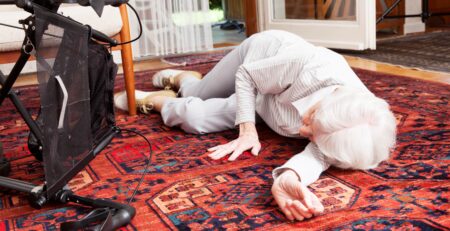
For any aged care facility manager or healthcare professional, fall prevention is a primary objective. A single fall can lead to serious injuries, hospitalisation, and a devastating loss of confidence for a resident. This is precisely why a smart, integrated strategy for mobility and patient monitoring is so crucial.
These devices aren’t just about getting from A to B; they are fundamental to a resident’s dignity and self-worth. By providing the right level of support, you empower older adults to move around their home safely, join in on activities, and hold onto that all-important feeling of self-reliance. The goal is to match the person’s needs with a tool that provides stability, seamlessly supported by a technological safety net.
The Impact of an Integrated Approach
A proactive approach to mobility support creates a safer facility. It’s not just about handing someone a walking frame. It involves proper assessment and careful selection, integrated with sophisticated patient safety technologies. For instance, a resident using a walker is already safer, but when you pair that with a bed alarm or wearable fall detection devices Australia trusts, you create a powerful, responsive safety system.
This layered approach to patient safety is at the heart of modern aged care. The diagram below illustrates how different strategies work together to reduce falls, highlighting the superior effectiveness of an integrated system.
As you can see, combining physical aids with monitoring technology provides the greatest impact on reducing fall-related incidents.
By viewing mobility aids as a core part of a broader fall prevention ecosystem, facilities can shift from reacting to falls to actively preventing them. This strategy doesn’t just manage risk—it builds a more secure and empowering environment for every resident.
Ultimately, understanding the full range of mobility solutions and safety technologies is the first step. When you select reliable, Australian-compliant equipment, you build trust and ensure every resident gets the support they need to live safely and with dignity. Horizon is your specialist partner, offering trusted nurse call systems Australia wide and monitoring products that integrate seamlessly with your mobility strategies.
Understanding the Main Types of Mobility Aids
Choosing the right mobility aid is a critical clinical decision. The success of a resident’s independence and safety hinges on matching the aid to their specific physical and cognitive needs.
Not every mobility challenge is the same, so the aids designed to help are vastly different. Let’s break down the main categories of mobility aids for elderly individuals to provide a clear framework for professional assessment. We’ll start with the simplest supports and build from there.
Canes: For a Little Extra Balance and Stability
Canes represent the first tier of support. They are ideal for individuals who are generally mobile but require minor balance correction, confidence reinforcement, or occasional weight-bearing assistance.
A cane provides a third point of contact with the ground, reducing the cognitive load of worrying about a potential misstep. They are best suited for those with minor weakness or slight instability and are lightweight enough for navigating familiar indoor spaces or short walks. It is crucial to remember they are not designed to bear a person’s full body weight.
Walkers and Walking Frames: When More Support is Needed
When a cane is insufficient and a resident requires significant weight-bearing assistance, a walker or walking frame is the next logical step. These aids create a wide, stable base that the user stands within, dramatically lowering the risk of falls for those with more pronounced balance deficits or weakness.
A standard walking frame—without wheels—offers maximum stability as it must be lifted and placed forward with each step. In contrast, rollators (walkers with wheels, brakes, and often a seat) encourage a more fluid, natural walking pattern. They are perfect for those who have the coordination to manage them but need to take frequent rests.
The core function of a walker is to provide a secure perimeter of support. This not only prevents falls by correcting stumbles but also gives residents the confidence to stay mobile, which is essential for maintaining muscle strength and overall health.
This level of support is vital in aged care. In Australia, mobility aids are widely used, with approximately 93% of residents in aged care facilities depending on such devices. These tools are proven to enhance independence, improve safety by reducing falls, and increase participation in community life. You can discover more insights about the Australian mobility devices market and its impact on aged care.
Wheelchairs: For Seated Mobility
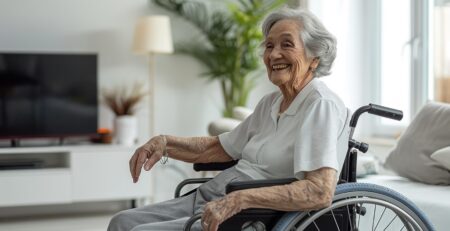
For individuals who cannot bear weight on their lower limbs or are unable to ambulate safely even for short distances, wheelchairs provide the essential function of seated mobility. They represent a significant step up in support, allowing residents to maintain their independence and participate in facility life when walking is no longer a safe option.
Manual wheelchairs are propelled by the user or a caregiver, making them a good fit for those with adequate upper body strength. Power wheelchairs, operated with a joystick, offer a high degree of autonomy for individuals with limited strength or more complex mobility challenges. The choice is determined by the user’s physical capacity and their daily environment.
Mobility Aid Categories at a Glance
This table offers a quick reference for matching a resident’s profile to the most suitable category of mobility aid.
| Aid Category | Primary User Profile | Main Function | Typical Environment |
|---|---|---|---|
| Canes | Minor balance issues, needs light support | Provides an extra point of contact | Indoor and short outdoor walks |
| Walkers | Significant balance issues, needs weight support | Creates a stable frame for walking | Primarily indoor use |
| Wheelchairs | Unable to walk or bear weight for any distance | Enables seated mobility and transport | Indoor and outdoor use |
This table serves as a starting point for a comprehensive assessment before specifying individual models and features.
Choosing the Best Canes and Walkers for Stability
Within a robust fall prevention strategy, canes and walkers form the bedrock of physical support. For aged care managers and clinical staff, understanding the critical differences between these mobility aids for elderly people is key to providing appropriate support. The goal is not to select the most complex device, but the one that precisely matches a resident’s unique stability, strength, and confidence levels.
This selection process is a clinical decision with significant consequences. The right choice can empower a resident to remain active and socially engaged, while an incorrect one can lead to fear of falling and social withdrawal.
A smart decision requires evaluating how each device performs in a real-world aged care environment. Facility managers must be confident that all equipment is reliable, safe, and meets Australian standards to protect both residents and the organisation.
Distinguishing Between Cane Types
Though seemingly simple, cane design directly influences the support offered. The choice between a single-point cane and a quad cane exemplifies how a minor design modification can serve vastly different clinical needs.
A single-point cane is the standard design. It offers light support and is best for residents who are fairly steady but require minimal balance correction or offloading of a sore joint. It functions as a tool for building confidence as much as for physical stability.
A quad cane, conversely, features a rectangular base with four small feet. This wider base provides a significant increase in stability, making it the ideal choice for someone with more pronounced balance issues or unilateral weakness.
For a resident recovering from a stroke, unilateral weakness is common. A quad cane provides a stable, fixed base of support, offering the security needed to advance the weaker leg—a function a single-point cane cannot safely provide.
A key practical benefit is the quad cane’s ability to stand independently. This frees the user’s hands, allowing them to sit or stand without needing to prop the cane against a surface where it could fall and become a trip hazard.
Selecting the Right Walker or Rollator
When a cane is insufficient, walkers and rollators provide a secure frame of stability. These aids are central to fall prevention for many older adults, but as with canes, the specific type chosen is critical.
A standard walker, or walking frame, has no wheels. The user must physically lift and place it forward with each step. As all four legs are grounded during movement, this design delivers maximum stability. It is the preferred option for residents with severe balance deficits or those who need to bear significant weight through their arms.
The disadvantage is the slow, fatiguing stop-start gait pattern. This is where a rollator excels.
A rollator is a walker with wheels, brakes, and typically a built-in seat. They are most common in three- or four-wheeled models.
- Three-Wheeled Rollators: Lighter and more manoeuvrable, they are well-suited for navigating tight indoor spaces like resident rooms or narrow corridors.
- Four-Wheeled Rollators: These offer a wider, more stable base of support and almost always include a seat. For many residents, this feature is a significant enabler.
The integrated seat on a four-wheeled rollator gives residents the confidence to ambulate further. Knowing a safe resting spot is always available encourages participation in facility activities, preserving both physical strength and social connections. For a facility manager, investing in high-quality, Australian-compliant rollators is a direct investment in resident independence, safety, and wellbeing.
Comparing Wheelchairs and Scooters for Seated Mobility
When an individual’s mobility becomes significantly limited, canes and walkers are no longer adequate. At this point, seated mobility aids for elderly people become essential for safety, socialisation, and maintaining a sense of independence.
For aged care facility managers, understanding the distinctions between manual wheelchairs, powered wheelchairs, and mobility scooters is critical for appropriate resident prescription. This decision must account for physical strength, cognitive ability, daily routines, and the physical environment. An incorrect choice can lead to discomfort, pressure injuries, or social isolation. A correct choice can be life-changing.
Let’s analyse the practical differences between these seated mobility options to guide your selection process.
Manual Wheelchairs: The Foundation of Seated Support
A manual wheelchair is often the initial choice for seated mobility. It is propelled either by the user pushing the large rear wheels or by a caregiver pushing from behind. This distinction is the first decision point.
- Self-Propelled Models: These are ideal for residents with good upper body strength and coordination. Self-propulsion helps maintain muscle tone and provides significant freedom to navigate their room, the dining hall, and other facility areas.
- Transit (or Attendant-Propelled) Models: With smaller rear wheels, these are designed solely to be pushed by a caregiver. They are typically lighter and more compact, making them a practical choice for residents unable to self-propel or for short-distance transfers.
Manual wheelchairs are highly versatile indoors, easily navigating doorways and furniture. However, proper fitting is non-negotiable. Incorrect seat width or depth can cause poor posture and significantly increase the risk of pressure injuries.
Powered Wheelchairs: For Independent Movement
For residents lacking the upper body strength for a manual chair, a powered or electric wheelchair is a game-changer. Operated with a simple joystick, these chairs empower individuals to move freely without physical exertion.
Modern power chairs are sophisticated devices. Many feature a tight turning radius, making them remarkably nimble indoors. Furthermore, numerous models are robust enough for outdoor use on footpaths and other smooth surfaces.
The primary benefit of a powered wheelchair is the autonomy it restores. It allows a resident with significant physical limitations to decide where and when they want to go, which is fundamental to their dignity and mental wellbeing.
These are complex pieces of medical equipment, not just motorised chairs. They can be customised with features like power tilt, recline functions, and elevating leg rests to manage pressure and support complex health needs. This level of customisation is crucial in advanced patient care.
Mobility Scooters: For Outdoor Freedom
While wheelchairs are designed for essential, everyday mobility, scooters are focused on lifestyle and community access. With a tiller for steering and a design resembling a small vehicle, scooters are built for longer distances and outdoor use.
They are an excellent choice for residents who can still walk short distances—for example, from their room to the facility entrance—but require assistance for longer journeys like visiting local shops or a park. Their larger size and wider turning circle make them less practical for navigating confined indoor spaces.
Ultimately, the choice requires a careful, individual assessment. It’s also vital to pair any mobility aid with appropriate safety monitoring, especially for high-risk users. Understanding how to integrate technologies like chair alarms and wireless sensor mats is a critical part of a comprehensive fall prevention strategy. Learn more in our guide on monitoring wheelchair use at home or in aged care.
How to Assess a Resident’s Mobility Needs
Selecting the right mobility aids for elderly residents is a clinical process that forms a cornerstone of any personalised fall prevention strategy. Success depends on a thorough, multidisciplinary assessment that considers the whole person.
The assessment acts as a detailed blueprint for a resident’s independence. Without it, equipment selection is merely guesswork, potentially leading to an aid that creates more problems than it solves. A proper assessment prevents dangerous mismatches, such as providing a rollator to someone who lacks the cognitive function to operate the brakes safely. It ensures the aid genuinely empowers them.
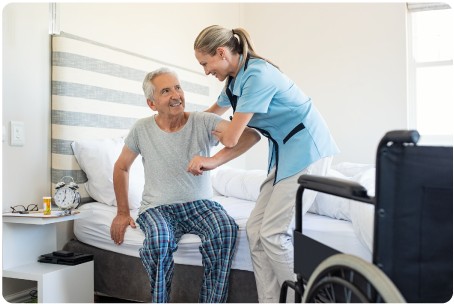
This process requires a team effort, involving the resident, their family, physiotherapists, and occupational therapists. Each stakeholder contributes unique insights, ensuring the final choice is safe, practical, and respects the resident’s dignity.
Key Areas of a Holistic Assessment
To ensure a comprehensive evaluation, a structured assessment should be built around several core pillars. This approach helps care managers and clinical staff build a complete picture of a resident’s abilities and limitations.
A comprehensive evaluation must cover:
- Physical Strength and Endurance: Can the resident support their own weight? Do they possess sufficient upper body strength to manage a manual wheelchair or a standard walker?
- Balance and Gait: How stable are they? Observe for any swaying, shuffling, or instability during ambulation and transfers, such as moving from bed to chair.
- Cognitive Awareness: Does the resident understand how to use the device safely? It is critical they can remember operational steps, like engaging a rollator’s brakes before sitting.
- Environmental Factors: What is their living space like? Consideration must be given to doorway widths, floor surfaces, trip hazards like rugs, and bathroom accessibility. A mobility aid is ineffective in an environment it cannot navigate.
The Importance of the Living Environment
A resident’s immediate surroundings are a critical factor in selecting the right mobility aid. A walker that is ideal for the wide, smooth corridors of an aged care facility may be a liability in a cluttered room. A detailed environmental assessment is non-negotiable.
Focusing on key monitoring areas within a resident’s room is vital for a complete fall prevention plan. You can learn more about optimising safety in our guide on aged care fall management for key areas in a resident’s room.
This has become even more important with the growing trend of in-home care. Australia’s mobility aid medical devices market, currently valued around USD 241.66 million, is projected to grow as the ageing population increasingly prefers to remain at home. This shift drives demand for aids suitable for home environments, supported by government initiatives to improve accessibility and affordability.
A successful assessment is an ongoing process. A resident’s needs can change rapidly following an illness or a fall. Regular reassessments are vital to ensure their mobility aid remains a tool for independence, not a hazard.
Integrating Aids into Your Fall Prevention Strategy
A mobility aid is an excellent tool, but it’s only one component of a much larger safety framework. Effective fall prevention is not just about providing a walker or a cane; it’s about creating a responsive safety net around the resident. This is where the physical support from mobility aids for elderly residents converges with smart, modern patient monitoring technology.
This integrated approach creates a far more secure environment. It shifts a facility’s focus from reacting after a fall to proactively preventing one. By layering different types of support, you close the safety gaps that a single solution can leave open.
A Layered Approach to Resident Safety
Consider a common scenario: a resident uses a four-wheeled rollator for stability during the day. However, the greatest risk often occurs at night when they attempt to get out of bed unassisted. This is a classic situation where a physical aid alone is insufficient.
By integrating technology, you create a complete safety system. The solution for this resident might include:
- A Wireless Bed Alarm: This sensor mat, placed under the mattress, detects when the resident leaves the bed and instantly sends a silent alert to the nearest caregiver via the facility’s hospital nurse call bell system.
- Low-Level Lighting: Motion-activated lights can illuminate a clear path from the bed to the bathroom, reducing disorientation and trip hazards in the dark.
This combination means that before the resident even takes their first unsteady step, a staff member is alerted and can provide assistance. The technology acts as a silent guardian, bridging critical moments of vulnerability.
Expanding the Safety Net with Advanced Monitoring
This strategy extends beyond the bedside. For more mobile residents or those at higher fall risk, other technologies are essential. For example, wireless sensor mats placed in doorways or beside chairs can monitor movement throughout a resident’s room, providing valuable data on behaviour patterns.
Furthermore, wearable fall detection devices Australia has available provide another crucial layer of security, automatically summoning help if a fall occurs. This is especially important for residents who may be unable to activate a call button themselves.
By combining physical mobility aids with intelligent monitoring systems like the range from Horizon, you create a seamless web of protection. This strategy ensures assistance arrives precisely when needed, dramatically reducing the likelihood of falls and serious injuries.
This integrated approach is the future of aged care safety, aligning with a holistic model that combines physical support with proactive monitoring. For more insights, explore our detailed article on fall prevention and personalised exercise programs.
As a specialist supplier of Australian-compliant nurse call systems Australia and monitoring products, Horizone is your partner in building these comprehensive safety solutions.
Your Questions Answered: A Guide to Mobility Aids
For healthcare professionals managing mobility aid provision, several practical questions frequently arise. Addressing assessment, funding, and training is key to ensuring these tools are used safely and effectively within your facility.
How Often Should a Resident’s Mobility Aid Be Reassessed?
A mobility aid should be considered a clinical prescription and reviewed regularly. A resident’s mobility needs should be professionally reassessed at a minimum of every six to twelve months.
However, an immediate reassessment is required following specific events. If a resident experiences a fall, a hospital admission, a significant medication change, or any observable decline in physical or cognitive function, a professional review by an occupational therapist or physiotherapist is essential to ensure the device remains safe, effective, and correctly adjusted.
Who Funds Mobility Aids for Seniors in Australia?
In Australia, funding for mobility aids is typically accessed through government programs, depending on the individual’s age and circumstances.
- For seniors over 65: The Commonwealth Home Support Programme (CHSP) may cover basic support, while a Home Care Package (HCP) can fund aids for more complex needs.
- For individuals under 65: The National Disability Insurance Scheme (NDIS) is the primary funding source. Mobility aids are typically funded under the ‘assistive technology’ category.
Is Staff Training Required for Using Mobility Equipment?
Yes, unequivocally. Comprehensive staff training is a fundamental component of workplace health and safety (WHS) in any aged care setting. It is essential for preventing injuries to both residents and staff.
Your team must be competent and confident in assisting residents with their specific aids. They require training on how to perform routine safety checks on equipment and, crucially, how to identify signs that a device needs repair or replacement. This ongoing education is the bedrock of a robust fall prevention strategy.
Effective training does more than meet compliance requirements; it empowers your team to be proactive. It transforms every interaction into an opportunity to safeguard a resident’s wellbeing and reinforces their critical role in maintaining a safe environment.
At Horizon, we specialise in creating safer care environments. Our Australian-compliant nurse call systems, bed alarms, and patient monitoring technologies are designed to integrate seamlessly with your mobility support and fall prevention strategies. Explore our solutions to discover how we can help you enhance resident safety and improve care efficiency.